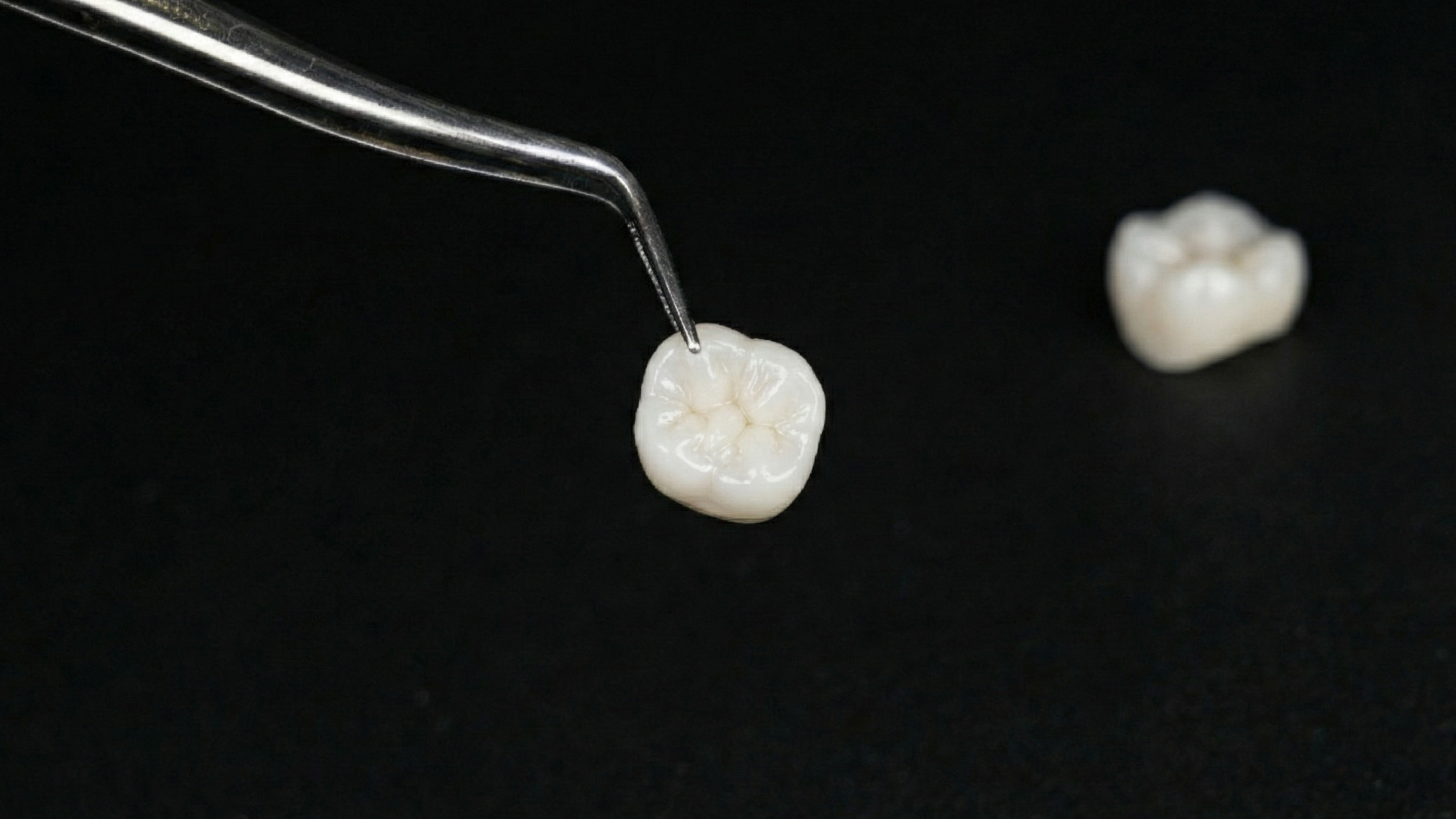
Quick answer: If your crown comes loose, take it out of your mouth so you can't swallow it, keep it in a clean bag or container, and call your dentist the same day. Avoid chewing on that side and don't glue it back yourself. Most loose crowns can be checked within a day or two, and many can be re-cemented.
You're halfway through dinner when something hard and smooth lands on your tongue. It isn't food.
You fish it out and realize it's your crown. The tooth underneath feels small, sharp and strange. Maybe it's cold-sensitive. Maybe it doesn't hurt at all, which is somehow more confusing.
Your first questions are the obvious ones. Is this an emergency? Can I push it back on? Did I just lose an expensive piece of dental work for good?
The simple answer is… keep the crown, protect the tooth and get it checked soon. In many cases the crown simply goes back on with fresh cement.
The more honest answer is… a crown rarely falls off for no reason. The cement may have worn out, but decay underneath, a cracked tooth or, on an implant, a loose screw can also be the cause. What happens next depends on which one it is.
The crown is usually the easy part. The tooth or implant underneath is what needs looking at.
What Should I Do First If My Crown Came Loose?
These first steps protect you and give your dentist the best chance of reusing the crown.
- Take it out if it's wobbling or already off. A crown loose in your mouth can be swallowed or, more rarely, breathed in. Dental objects that end up in the airway are uncommon, but they can become a medical emergency (Huh, 2022).
- Keep the crown safe. Rinse it gently, let it dry and put it in a small bag or pill box. Don't scrub the inside.
- Look at the tooth. Note whether there's a piece of tooth inside the crown, a broken edge or a post sticking up.
- Keep the area clean. Brush gently and rinse with warm water. Food trapped against the exposed tooth is uncomfortable and feeds decay.
- Chew on the other side. The tooth under a crown has been shaped smaller and is weaker without its cover.
- Call your dentist. Describe what happened, whether it hurts, and whether the crown is on a natural tooth or an implant.
If you aren't sure whether it's on a tooth or an implant, that's fine. An X-ray answers it in seconds.
Is a Loose Crown a Dental Emergency?
Usually it is urgent, not an emergency. You should be seen soon, but you don't need a hospital at midnight for a crown that came off without pain.
Call the same day and ask to be seen right away if you have:
- Strong or throbbing pain, or pain that wakes you up
- Swelling of the gum, face or jaw
- A broken tooth, a piece of tooth inside the crown, or a sharp edge cutting your tongue
- A crown you think you swallowed or inhaled, especially with coughing or trouble breathing (go to emergency care for breathing problems)
- An implant crown that moves together with the implant itself
For patients in Los Angeles, West LA Implants keeps same-day emergency appointments on weekdays at our office on Wilshire Blvd, minutes from Brentwood, Santa Monica, Westwood, Century City and Culver City. Our general and emergency dentistry team sees broken crowns and restorations often.
Why Do Crowns Come Loose?
Crowns are reliable, but they aren't permanent in the way natural enamel is. A large review of fixed dental work found that loss of retention, the crown coming unstuck, happened in about 2% of single crowns, alongside other problems like porcelain chipping and the tooth needing a root canal (Goodacre et al., 2003).
The most common reasons we see are:
- Decay under the edge of the crown. New decay can soften the tooth the crown is cemented to. Decay was the most common problem reported under bridge supports in the same review (Goodacre et al., 2003).
- Cement wearing out. Years of chewing, grinding and temperature change take a toll.
- Sticky or very hard food. Caramel, taffy, ice and hard candy pull on or overload a crown.
- Crown material and design. In one systematic review, zirconia crowns lost retention more often than metal-ceramic crowns (Sailer et al., 2015).
- A short or broken tooth underneath. When there's little tooth left to hold onto, the crown has less grip.
The Biggest Difference: A Crown on a Tooth vs. a Crown on an Implant
A loose crown on a natural tooth and a loose crown on an implant feel the same in your mouth. They are very different problems.
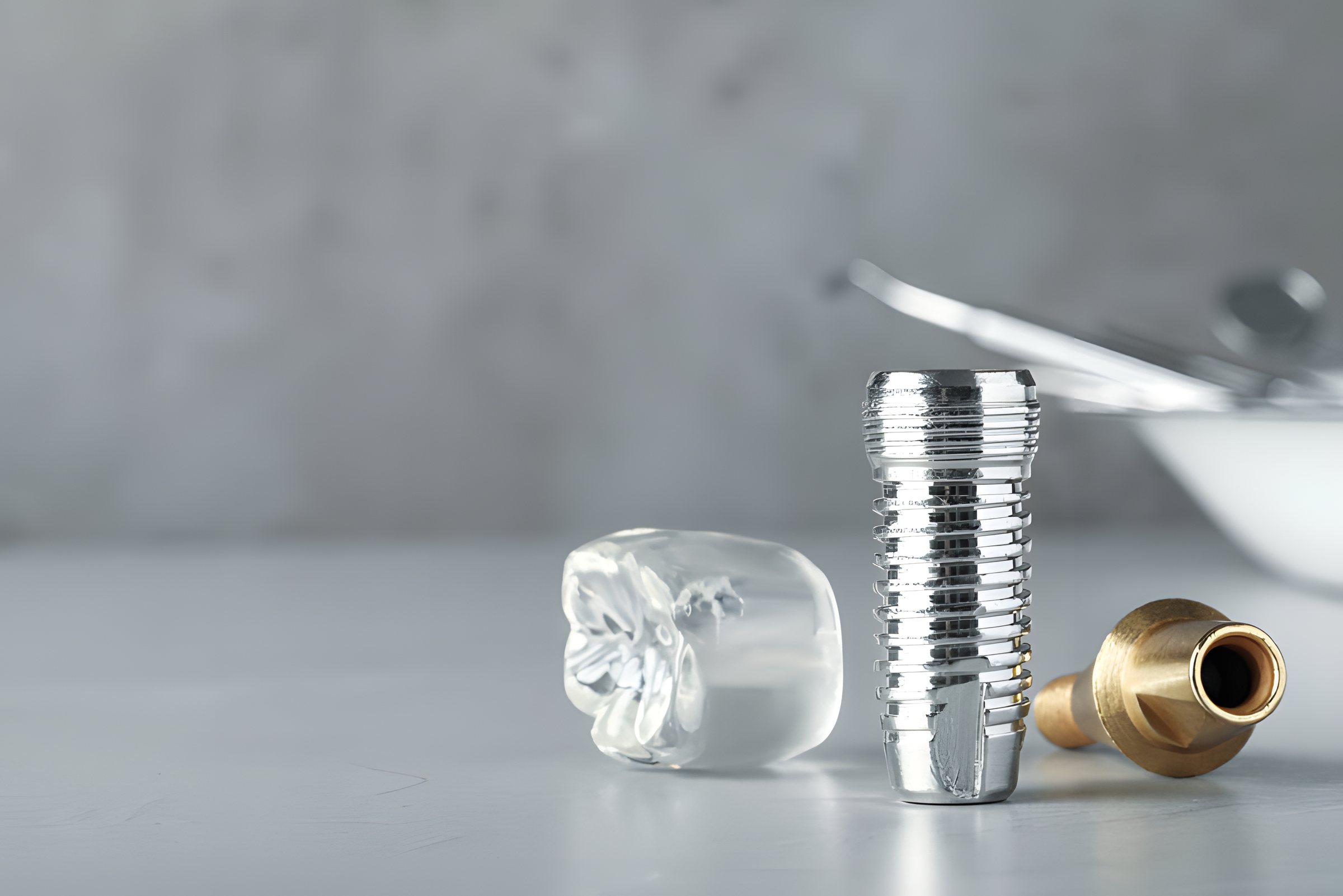
On a natural tooth, the crown is cemented to what's left of the tooth. On an implant, the crown sits on a connector called an abutment, which is held to the implant by a small screw or by cement (here's how those parts fit together).
Implant crowns are very successful overall, but small mechanical problems are common. A systematic review found that screw or abutment loosening affected about 12.7% of implant crowns within five years (Jung et al., 2008).
| Crown on a natural tooth | Crown on an implant | |
|---|---|---|
| What usually lets go | The cement, or the tooth underneath | The abutment screw, the cement, or (rarely) the implant itself |
| What it feels like | Crown pops off, tooth may be sensitive | Crown wobbles or clicks, usually no sensitivity |
| Main thing to check | Decay, cracks, how much tooth is left | Screw, abutment, gum health, bone around the implant |
| Typical fix | Clean and re-cement, or a new crown | Re-tighten or replace the screw, re-cement, or re-make the crown |
| When it's more serious | Tooth broken at or below the gum | The implant itself moves, or there's bone loss or infection |
If the whole implant moves, not just the crown, that points to a different problem. Our failing dental implants page explains how those cases are assessed.
Can I Glue My Crown Back On Myself?
Please don't use superglue or household adhesives. They aren't made for the mouth, they can seal decay under the crown, and they can make it harder for your dentist to clean and re-seat the crown properly.
Some pharmacies sell temporary dental cement. If you can't be seen for a few days and the crown is clean, fits fully and doesn't hurt, a small amount can hold it for a short time. If it doesn't seat easily, stop.
A crown pushed on crooked can change your bite, crack the tooth, or come off while you sleep.
Avoid sleeping with a loosely seated crown in your mouth, for the same airway reason above (Huh, 2022). Temporary cement is a bridge to an appointment, not a repair.
Can a Crown That Fell Off Be Put Back On?
Often, yes. If the crown is intact, fits well and the tooth underneath is healthy, your dentist can clean both surfaces and cement it again in the same visit.
A new crown is the better choice when:
- There is new decay that has to be removed first, which changes the tooth's shape
- The crown is cracked, chipped or no longer fits closely at the gumline
- The tooth broke and needs a buildup or a post before a crown will hold
- The crown is very old and the margins have opened up
Our office designs and mills many crowns in house and offers same-day crowns, so in suitable cases a replacement doesn't mean weeks in a temporary.
What We Look at Before Recommending Re-Cementing, a New Crown or an Implant
We don't decide from the crown alone. Before recommending anything, we look at:
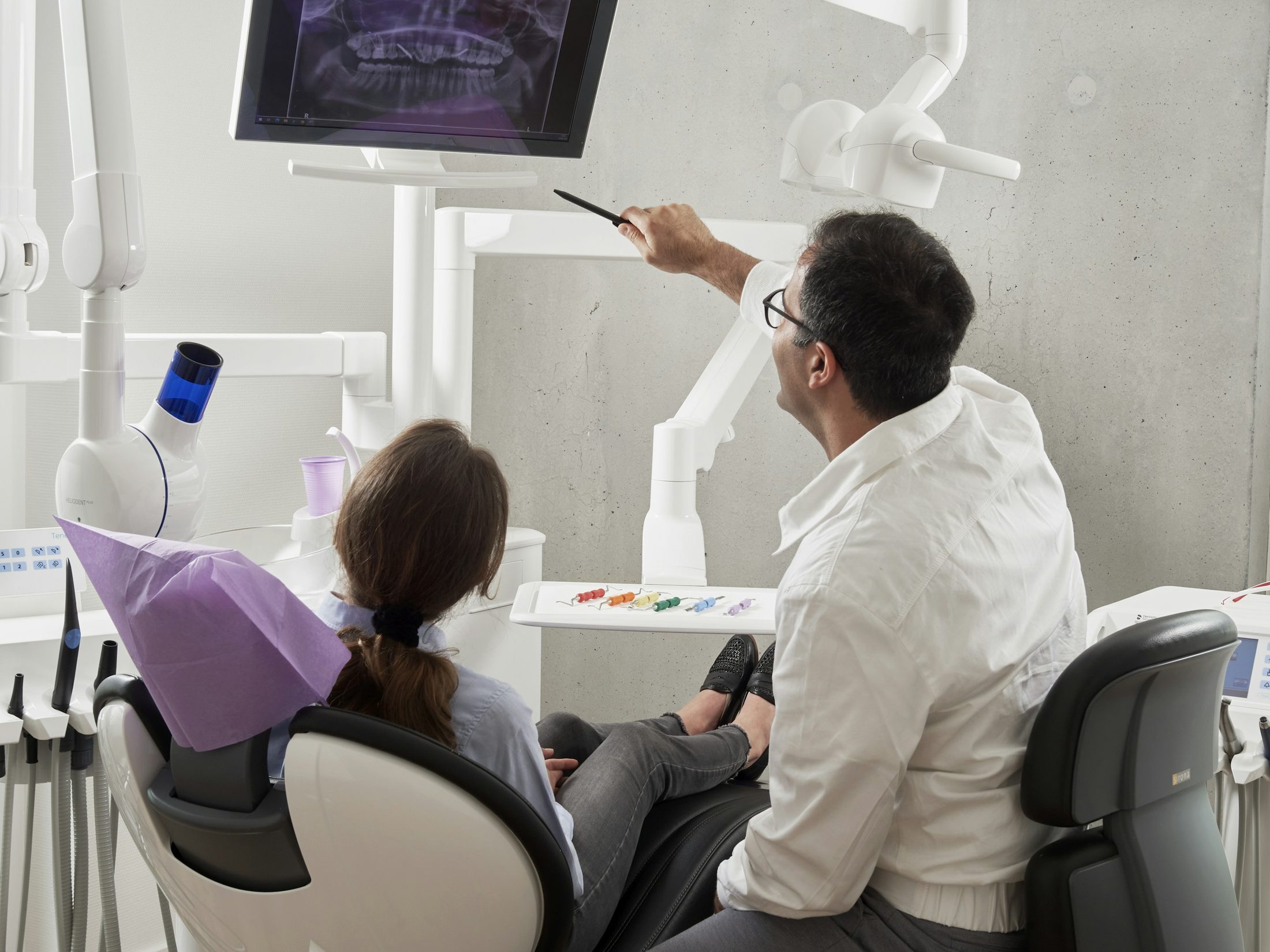
- The X-ray. Is there decay under the old margin? Is the root intact? Is there infection at the tip of the root?
- How much healthy tooth is left. A crown needs enough tooth structure to grip. Too little, and re-cementing simply buys time.
- Whether the tooth had a root canal. Root-canal-treated teeth depend on their crowns. In one University of Iowa study, root-canal-treated teeth that weren't crowned were lost at about six times the rate of those that were (Aquilino & Caplan, 2002). Leaving one uncovered for long is a real risk.
- The crown itself. Fit, cracks, wear and whether it still matches your bite.
- Your bite and habits. Grinding or clenching may need a night guard, or the next crown will meet the same fate.
- For implant crowns: the screw, the abutment, the gum around the implant and the bone level. Where we need a 3D view, we use our cone-beam CT scanner.
If the tooth can't be saved, we'll talk about extraction and replacement options honestly. That's the exception, not the rule.
What Happens If I Wait Too Long?
A few days is usually fine. Weeks or months is where the risks add up.
- Sensitivity. The exposed tooth has open dentin, which can react sharply to cold, sweets and air (West et al., 2013).
- More decay. The unprotected tooth is easier for plaque and decay to attack.
- A crown that no longer fits. Teeth can move. In a study of adults who had lost back teeth, 92% of the teeth left without a biting partner had drifted toward the gap (Craddock et al., 2007). Even small shifts can stop the old crown from seating.
- Fracture. The tooth underneath is shaped thin. Without its cover, a hard bite can break it, sometimes below the gum.
The longer the crown is out, the more likely you'll need a new one instead of a quick re-cement.
Risks and Limits of Re-Cementing a Crown
Re-cementing is quick and often successful, but it has limits.
If the crown came off because of decay or because there's very little tooth left, new cement won't fix the cause. It may come off again.
On implants, a screw that keeps loosening can point to a bite problem or a worn part. Replacing the screw and checking the bite is part of a proper fix (Jung et al., 2008). Both screw-held and cemented implant crowns perform well overall, so the right repair depends on how yours was made (Wittneben et al., 2014).
We'll tell you plainly if a re-cement is a short-term fix rather than a lasting one.
How Much Does It Cost to Fix a Loose Crown?
We can't give a fair number until we've seen the tooth, because the fix ranges from simple re-cementing to a new crown, a buildup, or treating the tooth underneath.
In general, re-cementing a crown that still fits costs much less than a new one. Costs rise when there's decay to treat, a broken tooth to rebuild, or an implant part to replace.
- We're in network with most PPO dental plans and file claims for you. How your plan treats crowns and implant repairs varies, and our guide to dental implant insurance explains the terms to look for.
- Patients without insurance can use our in-house savings plan, and financing is available for larger treatment.
- You'll get a written quote before any treatment beyond the emergency visit.
Frequently Asked Questions
What if it was my temporary crown that came off?
Temporary crowns are held with a softer cement so they can be removed later, so this is common. Call the office so it can be re-cemented, because the temporary keeps the tooth from shifting before your final crown is ready.
Why does my crown keep coming loose?
A crown that loosens more than once usually has a cause: decay, too little tooth to hold it, a bite that overloads it, or, on an implant, a worn screw. Repeated re-cementing without finding that cause rarely lasts.
Is it normal for the tooth under my crown to look dark or tiny?
Often, yes. The tooth was shaped smaller to make room for the crown, and root-canal-treated teeth or old metal can make it look darker. Your dentist will check it for decay either way.
Should I go to a hospital emergency room for a crown that fell off?
Only if you have trouble breathing, think you inhaled it, or have major facial swelling or a high fever. Otherwise, a dental office can treat it better and faster.
Can a loose implant crown be fixed the same day?
Often, if the crown and implant are healthy and only the screw or cement let go. It helps to know your implant's brand or where it was placed, so bring any records you have.
Will my insurance pay to re-cement a crown?
Some dental plans include a benefit for re-cementing a crown, with limits that differ from plan to plan. Our front desk will check your benefits before treatment.
Final Takeaways
- Take a loose crown out of your mouth, keep it safe and call your dentist the same day.
- Pain, swelling, a broken tooth or a swallowed crown need prompt attention.
- Don't use superglue. Temporary dental cement is a short-term stopgap only.
- A crown on an implant usually loosens at the screw or cement, which is a different fix from a crown on a natural tooth.
- Many crowns can be re-cemented. Decay, cracks or too little tooth may mean a new crown.
- Waiting weeks increases the risk of decay, tooth movement and fracture.
Get Your Crown Checked at West LA Implants
If your crown has come loose, call us at (310) 692-9316 for new patients or (310) 481-0111 for current patients. We keep same-day emergency appointments Monday to Friday.
Bring the crown with you. We'll take an X-ray, tell you whether it can go back on, and give you a written plan if it can't. You can also request an appointment online.
Already have implants? Our guide to caring for your dental implants covers the daily habits that help prevent problems.
Research References
- Goodacre CJ, Bernal G, Rungcharassaeng K, Kan JY. Clinical complications in fixed prosthodontics. J Prosthet Dent. 2003;90(1):31-41. doi:10.1016/s0022-3913(03)00214-2. https://pubmed.ncbi.nlm.nih.gov/12869972/
- Sailer I, Makarov NA, Thoma DS, Zwahlen M, Pjetursson BE. All-ceramic or metal-ceramic tooth-supported fixed dental prostheses (FDPs)? A systematic review of the survival and complication rates. Part I: Single crowns (SCs). Dent Mater. 2015;31(6):603-623. doi:10.1016/j.dental.2015.02.011. https://pubmed.ncbi.nlm.nih.gov/25842099/
- Jung RE, Pjetursson BE, Glauser R, Zembic A, Zwahlen M, Lang NP. A systematic review of the 5-year survival and complication rates of implant-supported single crowns. Clin Oral Implants Res. 2008;19(2):119-130. doi:10.1111/j.1600-0501.2007.01453.x. https://pubmed.ncbi.nlm.nih.gov/18067597/
- Wittneben JG, Millen C, Brägger U. Clinical performance of screw- versus cement-retained fixed implant-supported reconstructions: a systematic review. Int J Oral Maxillofac Implants. 2014;29 Suppl:84-98. doi:10.11607/jomi.2014suppl.g2.1. https://pubmed.ncbi.nlm.nih.gov/24660192/
- Aquilino SA, Caplan DJ. Relationship between crown placement and the survival of endodontically treated teeth. J Prosthet Dent. 2002;87(3):256-263. doi:10.1067/mpr.2002.122014. https://pubmed.ncbi.nlm.nih.gov/11941351/
- Huh JY. Foreign body aspirations in dental clinics: a narrative review. J Dent Anesth Pain Med. 2022;22(3):161-174. doi:10.17245/jdapm.2022.22.3.161. https://pubmed.ncbi.nlm.nih.gov/35693357/
- West NX, Lussi A, Seong J, Hellwig E. Dentin hypersensitivity: pain mechanisms and aetiology of exposed cervical dentin. Clin Oral Investig. 2013;17 Suppl 1:S9-S19. doi:10.1007/s00784-012-0887-x. https://pubmed.ncbi.nlm.nih.gov/23224116/
- Craddock HL, Youngson CC, Manogue M, Blance A. Occlusal changes following posterior tooth loss in adults. Part 1: a study of clinical parameters associated with the extent and type of supraeruption in unopposed posterior teeth. J Prosthodont. 2007;16(6):485-494. doi:10.1111/j.1532-849X.2007.00212.x. https://pubmed.ncbi.nlm.nih.gov/17559530/